


Helonium: Exploring the First Molecule of the Universe
Helonium is a fascinating chemical species that has attracted significant attention from scientists studying the origins of the universe. Although the term may not be familiar to the general public, helonium plays an important role in astrophysics, chemistry, and our understanding of how matter evolved after the Big Bang.
Scientifically known as the helium hydride ion (HeH+), helonium is considered by many researchers to be the first molecular compound that formed in the universe. Its discovery and study have helped scientists gain valuable insights into the earliest stages of cosmic history and the processes that eventually led to the formation of stars, galaxies, and planets.

What Is Helonium?
Helonium is a positively charged ion composed of one helium atom and one hydrogen atom. Its chemical formula is HeH+, meaning it contains a helium nucleus bonded to a hydrogen nucleus while carrying a positive electrical charge. Unlike many familiar molecules found on Earth, helonium is highly reactive and exists only under specific conditions. Because of its unusual structure and properties, it has become a subject of intense scientific interest. Scientists also refer to helonium as the helium hydride ion, and it is recognized as the simplest heteronuclear ion known in chemistry.
The importance of helonium goes far beyond its chemical simplicity. Researchers believe that it was the first molecule to emerge after the Big Bang, making it a crucial piece of evidence in understanding how the universe evolved from a hot, dense state into the complex cosmos we observe today.
The Origin of Helonium in the Early Universe
Shortly after the Big Bang, the universe consisted mainly of hydrogen and helium atoms. As the universe expanded and cooled, conditions became favorable for these atoms to interact. Scientists theorized that helium atoms could combine with hydrogen ions to create helonium, forming the first molecular bond in cosmic history. This process is believed to have occurred roughly 100,000 years after the Big Bang, marking the beginning of chemistry in the universe.
For decades, the existence of helonium in space remained a theoretical prediction. Researchers could create the ion in laboratories, but proving that it naturally existed in the cosmos was much more challenging. The molecule’s rarity and the difficulty of detecting its spectral signature meant that scientists had to wait many years before obtaining direct evidence.
Discovery and Detection
It was first produced experimentally in laboratories in 1925. Scientists were able to create and study its behavior under controlled conditions, confirming its unique chemical properties. However, despite nearly a century of research, astronomers struggled to detect it in space.
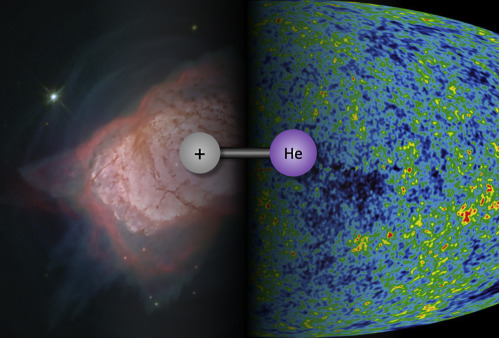
A major breakthrough occurred in 2019 when astronomers successfully identified helonium in a planetary nebula known as NGC 7027. This discovery confirmed long-standing theoretical predictions and provided strong evidence supporting current models of the early universe. The detection was celebrated as a milestone in astrophysics because it validated decades of scientific research regarding the formation of the first molecules.
Unique Chemical Properties of Helonium
One of the reasons helonium fascinates scientists is its extraordinary chemical behavior. The ion possesses a strong positive charge and exhibits remarkable acidity. In fact, it is often described as one of the strongest known acids under theoretical conditions. Because helium is generally considered an inert noble gas, the ability of helium to form a stable bond with hydrogen challenges many common assumptions about chemical reactivity.
Helonium is also important because it has a permanent electric dipole moment. This property allows astronomers to detect it through spectroscopic observations. Without this characteristic, identifying the molecule in space would have been far more difficult. Its distinctive spectral signature serves as a valuable tool for researchers investigating the chemistry of interstellar environments.
Why Helonium Matters to Modern Science
The study of helonium helps scientists understand how the universe transitioned from a simple collection of particles into a chemically active environment. Molecules play a critical role in cooling interstellar gas clouds, which eventually collapse to form stars. By studying helonium, researchers can better understand the processes that triggered star formation in the early universe.
Furthermore, helonium serves as a testing ground for theoretical models in quantum chemistry and astrophysics. Because it is such a simple molecule, scientists can analyze it with remarkable precision. The knowledge gained from these studies contributes to broader research involving molecular interactions, plasma physics, and cosmic evolution.
Helonium and Future Research
Even though helonium has already provided groundbreaking insights, researchers continue to investigate its properties and behavior. Modern telescopes and advanced detection technologies are enabling astronomers to search for helonium in additional regions of space. These observations may reveal more about the environments where the molecule forms and how it influences the evolution of galaxies and stars.
Scientists are also using laboratory experiments to simulate conditions found in interstellar space. By recreating these environments, they can better understand the formation and destruction of helonium and related ions. Such research helps bridge the gap between theoretical predictions and real-world observations.
Conclusion
Helonium is much more than an obscure chemical ion. As the helium hydride ion, it represents a vital link to the earliest moments of the universe and is widely regarded as the first molecule ever formed after the Big Bang. From its laboratory creation in 1925 to its confirmed detection in space in 2019, helonium has played an essential role in advancing our understanding of cosmic history. Its unique chemical properties, scientific significance, and connection to the origins of matter ensure that helonium will remain an important subject of research for years to come. Through continued study, scientists hope to unlock even deeper insights into the birth and evolution of the universe itself.
