

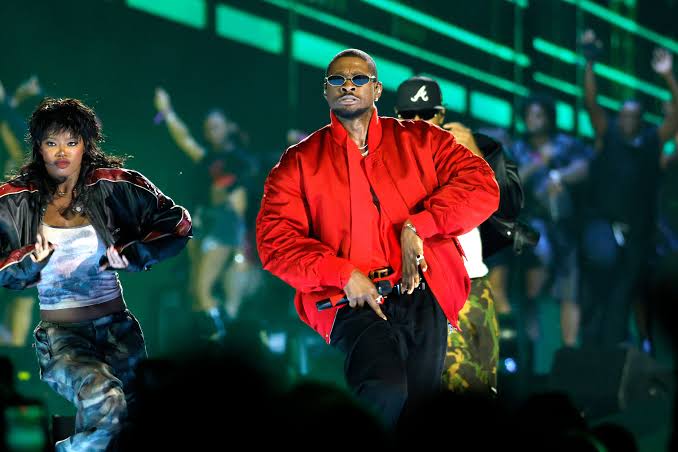

Usher has responded to bizarre internet rumours claiming that the famous singer is a clone. The strange theory has spread across social media, where some users have questioned whether the musician is really the same person they have watched perform for decades.
The Usher clone rumours have attracted attention because of comparisons between old photographs, recent appearances and changes in the singer’s look over the years. However, there is no credible evidence supporting the claim that Usher has been replaced by a clone.
Instead, the discussion appears to be another example of how quickly unusual celebrity theories can spread online.

Usher clone rumours : Usher Addresses the Strange Rumours
Usher is no stranger to public attention. Throughout his career, the singer has experienced major changes in his appearance, music and public image.
That long career has now become part of an unusual online debate.
Some social media users have claimed that the person appearing as Usher today looks different from the performer they remember from earlier years. Those comparisons have led to speculation about whether he has somehow been replaced.
The singer has now addressed the bizarre claims directly, giving fans a chance to hear his response rather than relying on social media speculation.
His reaction has also brought renewed attention to the unusual theory.
Usher clone rumours : How the Clone Theory Started
Celebrity clone theories are not new. Over the years, similar claims have been made about numerous famous musicians, actors and other public figures.
Usually, these theories begin with comparisons between photographs or videos taken years apart. Differences in hairstyles, facial features, body shape, fashion or even speaking style can then be presented online as evidence of something much more mysterious.
The same pattern appears to be behind the Usher clone rumours.
Usher has been in the public eye since he was young. Because there are decades of photographs and videos available online, fans can easily compare different periods of his life.
However, people naturally change as they age. Weight can fluctuate, hairstyles change and makeup, lighting and photography can dramatically affect someone’s appearance.
Social Media Makes Celebrity Rumours Spread Quickly
Social media has made it easier than ever for unusual theories to reach millions of people.
A single post comparing two pictures can quickly become a viral discussion. Other users may then add their own theories, creating a chain of speculation that becomes increasingly difficult to separate from fact.
That can be particularly powerful when the celebrity involved has had a long career.
In Usher’s case, fans have seen him evolve from a young R&B performer into an internationally recognized entertainer. His style and appearance have naturally changed during that period.
Yet online comparisons can sometimes make ordinary changes appear suspicious.
Why People Believe Celebrity Clone Theories
There are several reasons why celebrity clone theories continue to attract attention.
First, famous people are photographed and recorded constantly. That gives internet users an enormous amount of material to compare.
Second, digital platforms reward content that generates strong reactions. A strange claim can attract more comments, shares and views than a straightforward explanation.
Finally, people are naturally interested in mysteries. A theory suggesting that a celebrity has been secretly replaced is far more dramatic than simply saying that the person looks different because they have aged.
That combination can turn an unsupported claim into a viral conversation.
There Is No Evidence That Usher Is a Clone
Despite the online speculation, there is no reliable evidence showing that Usher is a clone or that a different person has secretly replaced him.
Photographs that appear different from one another do not establish such a claim. A person’s appearance can change significantly over several years, particularly when the images were taken under different lighting conditions or with different cameras.
Other factors can also affect how someone looks. Hairstyles, facial hair, clothing, camera angles and editing can all create noticeable differences.
For a celebrity who has spent decades in the public spotlight, these differences are especially easy to find.
Usher Has Had a Long Career in the Spotlight
Usher’s career provides plenty of context for the discussion. He became one of the biggest names in R&B and pop music and built a reputation through hit records, major performances and worldwide tours.
His career has also included major changes in music and entertainment.
As his public image evolved, so did his appearance. Fans who first discovered him years ago may naturally notice differences when comparing those early images with recent photographs.
That does not make the differences evidence of anything unusual.
Instead, it reflects the reality of a performer who has spent much of his life in front of cameras.
Fans React to the Unusual Claim
The reaction to the clone theory has been mixed.
Some social media users have treated the discussion as a joke, while others have seriously questioned whether there could be more behind the changes they see.
Many fans, however, have pointed out that Usher has been publicly visible for decades. His extensive career history provides a large record of performances, interviews and public appearances.
That makes the clone theory difficult to support with anything more than speculation.
The debate also demonstrates how quickly a humorous or exaggerated social media post can become a wider discussion once enough people begin sharing it.
Why Celebrity Privacy Still Matters
Although public figures live under intense media attention, that does not mean every rumor deserves to be treated as fact.
Celebrity speculation can sometimes become invasive, particularly when internet users make serious claims without evidence.
In Usher’s case, the clone rumours may seem harmless or amusing to some people. However, the episode highlights a broader issue surrounding online celebrity culture.
People can take an old photograph, compare it with a new one and build an entire theory around small differences. Once the claim spreads, correcting it can become much harder.
The Internet’s Endless Celebrity Rumour Cycle
The unusual story surrounding Usher is another example of the internet’s fascination with celebrity mysteries.
For years, famous people have faced rumours about secret replacements, hidden identities and unexplained changes. Social media has simply made these theories easier to distribute.
Usher’s response has therefore attracted attention not only because of the claim itself, but also because it shows how celebrities can become part of viral online conversations without intending to.
For now, the Usher clone rumours remain an unsupported internet theory rather than a fact.
The singer’s response gives fans a direct reaction to the speculation, while the available evidence provides no credible reason to believe that Usher has been replaced by a clone.
Ultimately, the story is a reminder to approach viral celebrity claims carefully. Social media can make almost any unusual theory appear convincing when enough people repeat it, but repetition is not proof. When extraordinary claims appear online, checking reliable information remains far more useful than relying on viral speculation.
